Google's Generative AI Leader certification is not an engineering course. It is a business level translation layer for people who need to sponsor AI work, buy AI products, or explain AI strategy inside an organisation.
That might sound like a criticism. It isn't, at least not entirely.
The cert is useful precisely because it draws a clean line between the polished story executives hear and the messy work engineers inherit. If you are the person translating between those two worlds, that line matters.
My take after going through it is simple: Google does a good job teaching the framing, the product vocabulary, and the adoption story. It does a much weaker job on the parts that decide whether an AI system survives contact with production.
So this is not a study guide. It is a practitioner's read on what the cert gets right, where it goes soft, and who should actually spend time on it.
What the cert is actually for
The GAIL sits at the foundational tier of Google Cloud certifications. The official exam is 90 minutes with 50 to 60 multiple choice questions, and it focuses on four areas: gen AI fundamentals, Google Cloud's gen AI offerings, techniques for improving model output, and business strategy for successful adoption.
That scope tells you a lot. This is not trying to turn anyone into an AI engineer. There are no labs, no design exercises, and no pressure to reason through hard system trade offs. The target person is someone who needs enough understanding to make decisions, set direction, and ask better questions.
Google's own description of a certified GAIL uses the word visionary. Engineers rarely describe themselves that way, which honestly made me laugh. Still, the intended audience is real: leads, managers, architects, and senior ICs who keep getting pulled into AI conversations that are half strategy and half product theatre.
If that sounds like your calendar, the cert is more practical than it looks.
What the cert gets right
The strongest part of the course is that it gives non specialists a usable mental model of the landscape. Not a perfect one, but a usable one.
Two parts stand out.
First, it teaches the difference between traditional task specific models and foundation models in a way that actually matters for decision making. Once you move into foundation model territory, the questions change. You are no longer just solving for accuracy on one bounded task. You are choosing between models, grounding approaches, latency budgets, cost envelopes, and data handling constraints. That framing is basic, but it is the right basic.
Second, the cert does a decent job showing the Google Cloud product surface without drowning people in implementation detail. Gemini, Gemma, Imagen, Veo, Chirp, Vertex AI, Model Garden. It is a tour of the shelf, which is exactly what many technical leaders need before they can make sense of build versus buy decisions. It also helps that Vertex AI is not a single-model world. Model Garden gives teams access to third-party models as well, which matters if you are evaluating multi-model patterns instead of treating Google's flagship as the only serious option.
It is also worth keeping an eye on where Google DeepMind is taking the Gemma line. MedGemma is a good example: a collection of open models optimised for medical text and image comprehension. It is not central to the cert, but it is a useful signal. Google's model story is no longer just "here is the flagship model" or "here is the open one". It is becoming more domain aware, which matters if you are thinking about regulated workloads or specialised internal platforms.
The one bit I especially liked was the layered stack model. It is the cleanest mental model in the course.
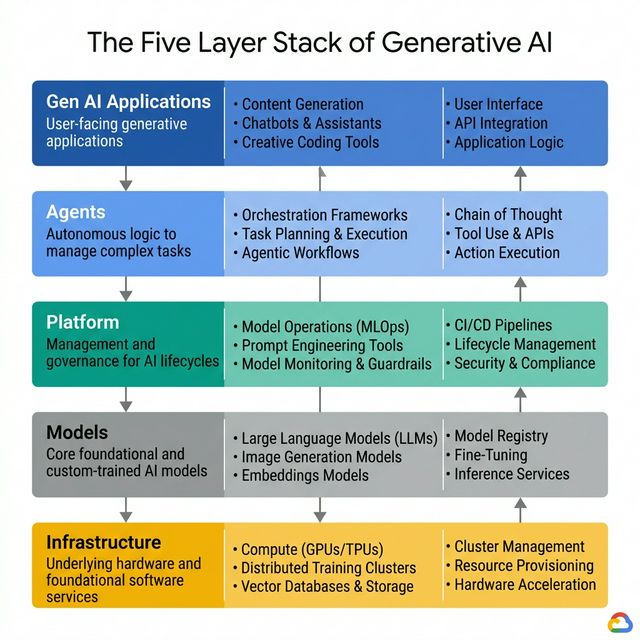
If you run a platform team, that stack maps nicely to ownership boundaries. Are you exposing model primitives, agent frameworks, or finished applications? How much of the stack do you want to own? Where do you want teams to self serve, and where do you want guardrails? Those are useful conversations, and the model helps structure them.
The two concepts worth remembering
If I had to keep only two things from the course, it would be these.
Grounding, RAG, and fine tuning
This is one area where Google explains the hierarchy well enough to save people from expensive mistakes.
| Technique | What it does | When to use |
|---|---|---|
| Prompt engineering | Shapes model behaviour through input construction | Start here |
| Grounding | Anchors output to verifiable data sources | Use when accuracy and traceability matter |
| RAG | Retrieves relevant context and injects it into the prompt | Use when the model needs current or proprietary information |
| Fine tuning | Adapts a base model to a domain or output pattern | Use when prompting and retrieval still do not get you where you need to be |
The important relationship is that RAG is one way to achieve grounding. Fine tuning is not the default answer to a knowledge problem. That sounds obvious once you say it out loud, but plenty of teams still reach for fine tuning when retrieval would solve the problem faster, cheaper, and with less operational pain.
My rule of thumb is the same one I use with teams: start with prompt engineering, add retrieval when you need fresh or private context, and only reach for fine tuning when the model's behaviour or output shape genuinely needs to change. If your knowledge base changes every week, which most enterprise knowledge bases do, RAG usually wins.
The cert also does the right thing with humans in the loop. It treats HITL as a design choice for high risk workflows, not as an embarrassing fallback for systems that are not good enough yet. More teams should think about it that way.
The five layer stack
The five layer stack is useful because it turns vague AI ambition into concrete platform choices. It helps leadership understand that not every company needs to build at the model layer, and it helps engineers explain why starting higher up the stack is often the sane choice.
That is also why the cert is more useful for internal alignment than for technical depth. It gives people shared language for decisions they were going to have anyway.
Where the course goes soft
The weak point of the certification is not that it is too simple. The weak point is that it makes the hard parts look cleaner than they are.
The most obvious example is agents.
The course presents an agent as a model plus tools plus a reasoning loop. Conceptually, that is fine. But it creates the impression that once you have those ingredients, you are mostly assembling a pattern. In practice, that is where the real engineering starts.
One useful distinction the course does make is between deterministic and generative agents. Deterministic agents follow fixed paths and predictable rules. Generative agents let the model decide what to do in the moment. Most production systems end up hybrid. You keep deterministic scaffolding around the parts that must be reliable and auditable, then use generative reasoning where flexibility is actually worth the risk.
The same goes for tooling. Google AI Studio is the quick way to prototype with minimal setup. Vertex AI Studio is where the conversation changes from experimentation to enterprise controls, auditability, and production data. That is a practical distinction, and it is worth understanding early because starting in the wrong environment usually makes the eventual migration more annoying than people expect.
Agents fail in boring, expensive ways. They call the wrong tool. They invent parameters that do not exist. They lose state across long interactions. They get stuck retrying the same path. They burn tokens on bad plans. They quietly degrade when prompts, schemas, or upstream APIs change.
That means the engineering work is not just "pick a model" or "choose ReAct". It is validation, retries, timeouts, tracing, evals, cost controls, auditability, and sane failure modes. None of that is glamorous, and none of it is optional if the system matters.
This is the real gap between AI leadership content and AI delivery. The leadership material tells you what the pattern is. The engineering reality decides whether the pattern is trustworthy.
The stakeholder framing is useful, but only up to a point
Google organises gen AI use cases into four buckets: Create, Summarise, Discover, Automate.
As a workshop tool, that is perfectly good. It helps non technical stakeholders move from "we should do something with AI" to a more specific conversation.
As a systems model, it is incomplete.
The highest value enterprise workflows usually chain those categories together. An incident flow might detect an anomaly, summarise what happened, draft a runbook update, and open a ticket. That is Discover, Summarise, Create, and Automate in one path. Treating those as separate lanes is helpful for teaching, but not how the interesting systems are built.
The augmentation versus automation distinction is more useful. Teams consistently underestimate how much risk they introduce when they move from "help a human decide" to "remove the human from the loop". The cert gets that part right, and more teams should take it seriously.
Prompting and responsible AI are treated correctly, but lightly
The course covers zero shot, few shot, role prompting, prompt chaining, humans in the loop, and Google's responsible AI principles. All of that belongs in a foundational cert, and none of it is wrong.
Still, this is another place where the course stops just before the painful bits.
Prompting in production is not just "write a better instruction". It is interface design. You are defining a contract between user intent and model behaviour, then versioning, testing, and maintaining that contract over time. That deserves more respect than most leadership material gives it.
The same goes for security. Google's Secure AI Framework is useful because it pushes the conversation across the full lifecycle, not just deployment day. That is the right frame. But the practical questions are still the ones platform teams have to answer for themselves: who can access which models, what data can flow where, how output is audited, and who owns the supply chain when something breaks.
That work does not disappear because a framework slide exists.
The strategy section is better than most cert content
Google argues for a multi-directional approach to AI adoption: top-down strategic vision combined with bottom-up team experimentation. The factors the course maps out are strategic focus (high-impact, feasible use cases first), exploration (empower teams to experiment), responsible AI (governance in the culture, not just the tools), resourcing (data, tooling, talent), impact (define KPIs before you deploy), and continuous improvement (iterate on real performance data).
The failure mode it is pointing at is real. Organisations that go top down without team buy in create mandates that nobody believes in. Organisations that go bottom up without a strategic thread end up with twenty demos and no operating model. The teams that move fastest are usually the ones where leadership creates permission for experimentation, and engineering feeds the resulting lessons back into strategy.
That sounds obvious on paper. In large companies, it rarely is.
This might be the section I would keep for non technical leaders even if I cut everything else. It is one of the few places where the course speaks honestly about adoption as an organisational problem, not just a product selection problem.
Who should actually do it
If you are a platform engineer or SRE already building AI systems, this cert probably will not teach you much that is technically new. What it will give you is a cleaner vocabulary for stakeholder conversations and a better read on the story Google is selling through Vertex AI. That has value, just not for the reason certification pages usually imply.
If you are a technical lead or engineering manager trying to drive AI adoption across an organisation, I think it is worth doing. You will leave with enough structure to separate sensible bets from vague enthusiasm, which is already more than most AI strategy conversations manage.
If you are a senior IC who keeps getting dragged into strategy sessions, this is also worth a day. Shared language with non technical counterparts matters more than most engineers like to admit.
The exam itself is straightforward if you have worked around these concepts before. The only questions that really matter are the scenario questions about matching needs to the right Google Cloud product or pattern. Those reward actual understanding of the product surface, not flashcard memorisation.
My advice is simple: spend a day on it, not a week. Learn the product vocabulary, understand the relationship between grounding, RAG, and fine tuning, remember the layered stack, and pay attention to the strategy material. Treat it like a foundational cert, because that is exactly what it is.
The real value is not the badge. It is the ability to sit in a room full of people using AI words loosely and steer the conversation back toward something concrete.
That alone can be worth the time.