A colleague reviewing your change is also learning what you are building. They need enough context to question a decision, help with the next change, or understand the system when something breaks.
Tomas Reimers gave that part of review a name, alignment, alongside validation and change management. His session at Cursor Compile London on 16 September 2026 examined what happens to all three as agents produce more code.
Cursor Compile London Series
- Pauline Brunet: AI Deployments at Scale
- David Gomes: Git Worktrees for Agents
- Murali Suriar: Diagrams and Shared Understanding
- Pablo Santos Luaces: How File Merges Work
- Tomas Reimers: Code Review in the Agent Erayou are here
- Jet Semrick: Grok Bot Workshop
My stage photographs and session notes identify Tomas as the speaker. The published programme lists Lauren Tan in the 14:30 slot. The notes below describe Tomas's review session.
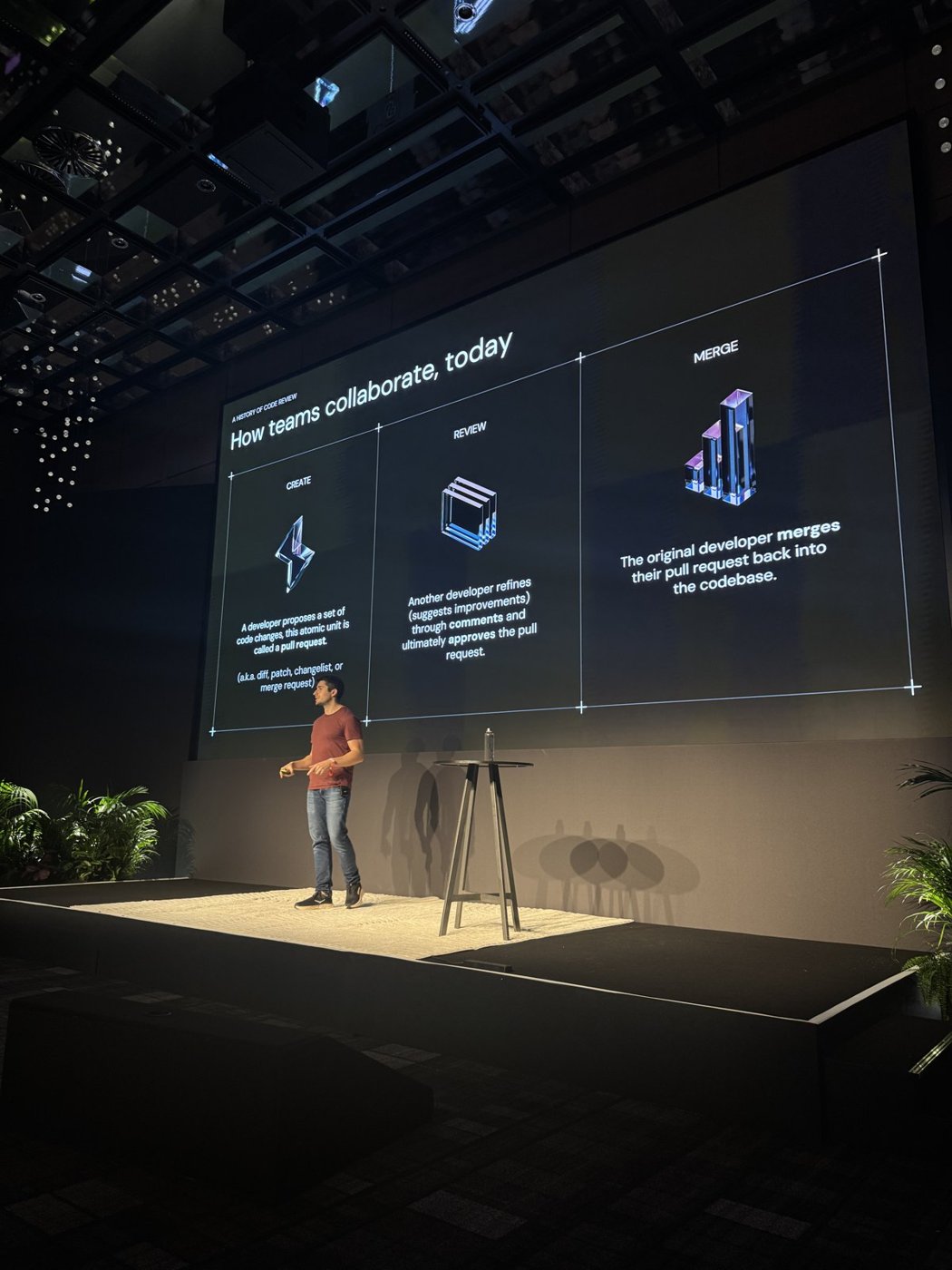
How Review Reached the Pull Request
Tomas traced review from paper inspections through emailed patches to web interfaces.
The paper process brought engineers together around printed code. Email made the change distributable and let reviewers insert comments alongside it. Web interfaces added syntax highlighting, navigable context, and comments attached to particular lines.
His examples included Fagan inspections, Google's Mondrian, and later review systems. The recurring structure remained familiar: create a change, ask someone to review it, revise it, and integrate it.
Validation
Validation asks whether the code behaves correctly: logic errors, missed cases, and changes that do not make sense.
Tomas discussed the rise of bots commenting on pull requests. The figure recorded in my notes was roughly a quarter of PRs in an open-source sample, compared with under 1% before around 2023. Those are speaker-reported figures; the dataset was not included in the session notes.
Automated validation can find defects and propose fixes. It does not establish that every change is correct or that the other purposes of review have been satisfied.
Change Management
A pull request is also a unit of change. Small, understandable changes are easier to integrate, deploy, and undo.
Agents increase the number of changes arriving for review. That creates coordination work even when each individual change passes its tests. Someone still needs to understand which changes belong together, which are blocked, and which are ready to merge.
Alignment
Review spreads knowledge about what the team is building and why. New joiners learn the system through it. Experienced engineers use it to question a direction before it becomes an established dependency.
More code arriving faster can leave the people responsible for the system with less shared context. Passing checks does not give a colleague the time or explanation they need to understand a decision. That work still needs a place in review.
Remove Manual Feedback Relays
The first proposed improvement was to stop using a person to copy review comments into an agent conversation.
When a bot identifies an actionable issue, the authoring agent should be able to receive it and prepare a fix. The human decision should remain visible where it is actually needed, rather than being mixed with repeated transcription of comments.
Direct Attention
A larger review queue needs help surfacing its state:
- Waiting for a response.
- Needs a reviewer.
- Has an unresolved decision.
- Has an agent-proposed fix.
- Ready to merge.
Tomas described attention management as part of the review product, rather than another task left entirely to the reviewer.
Review the Output
For a marketing site or internal tool, the generated interface is part of what needs reviewing. A code diff cannot show whether the page looks right, whether an interaction makes sense, or whether the result matches the brief.
The session's proposed direction broadened the review surface to include the artefact, alongside its implementation. Tomas described this work in the context of Origin's code-storage and review surface.